



 145 / 146

145
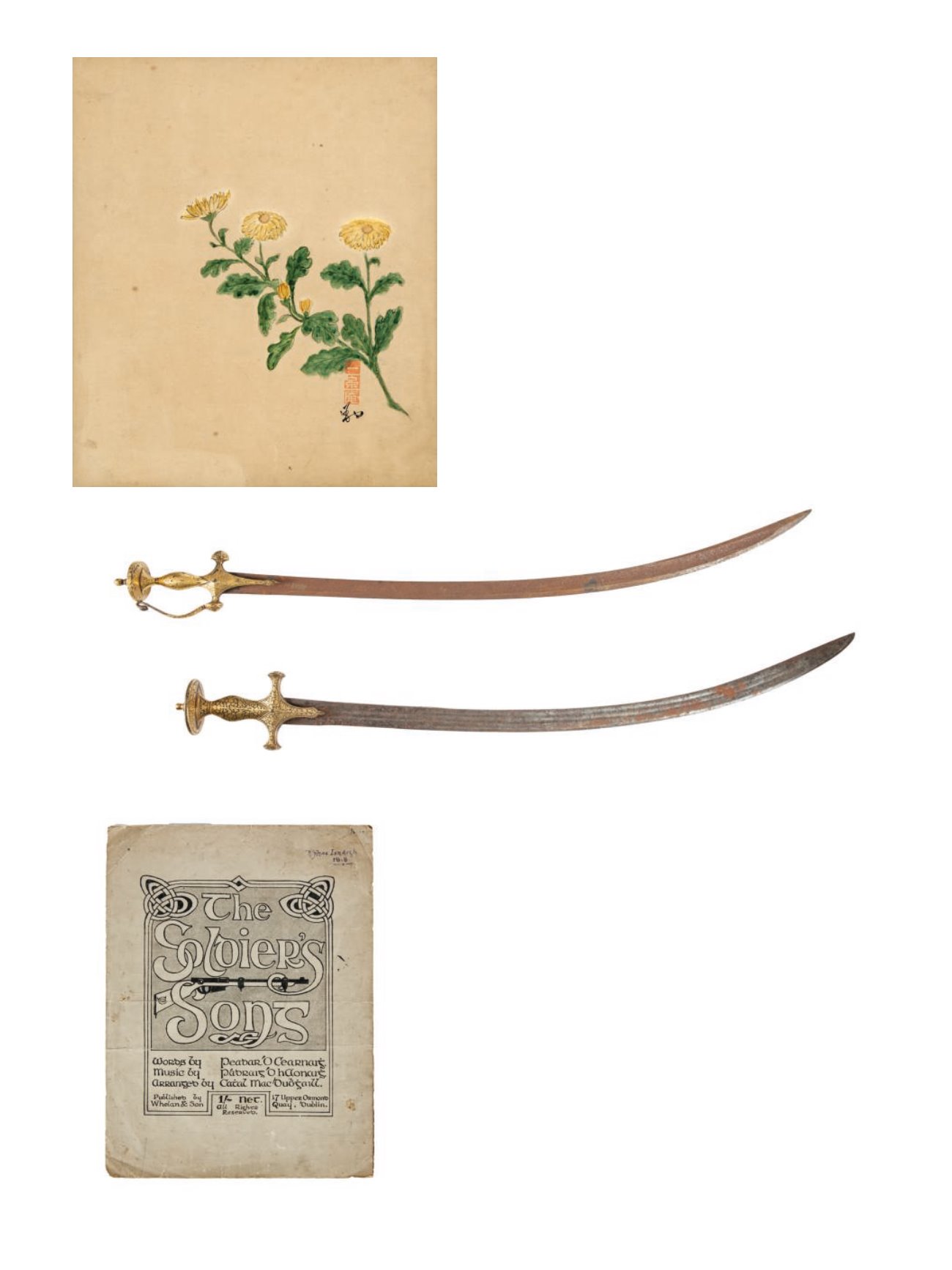
421 A COLLECTION OF THREE JAPANESE FRAMED WORKS(two framed and one contained in a plastic sleeve)
Two watercolours, one woodblock, various sizes
€200 - 300
422 A COLLECTION OF GEOGRAPHICAL SPECIMENS AND SHELLS€60 - 80
423 AN INDIAN KOFTGARI DECORATED TULWAR,18th/19th century, the hilt with bud finial and curved knuckle guard, fitted with a
single edge watered steel blade. 86cm long
€400 - 600
424 AN INDIAN MAINLUK REVIVAL TULWAR,18th/19th century, the hilt of typical form with Koftgari designs, fitted with a
curved, fullered single edge blade, stamped. 86cm long
€200 - 400
425 KEARNEY (PEADAR), THE SOLDIER’S SONG,FIRST EDITION WITH MUSIC
Four printed pages, 31 x 24cm approx. w.a.f.
Written in 1909-1910 by Peadar Kearney, music by Paddy Heaney and
arrangement by Cathal MacDubhgall. Later to become “Amhrán na bhFiann”
when it was translated to the Irish by Liam Ó Rinn in 1923 and becoming the
official Irish national anthem in 1926 following some debate about various
alternatives.
Peader Kearney was a founder member of the Irish Volunteers and The
Soldier’s Song was sung in the GPO during the Rising and was popular
among the Volunteers. As a result, later that same year (in December) it was
published by Whelan and Son, Dublin, 6. Seamus Whelan was a sympathiser.
The printer was Patrick Mahon of Yarnhall Street, who had also supplied
some type for the printing of the 1916 Proclamation. The cover design, with
rifle butt signed in a stylised C.macD., is by Cathal Mac Dúbhghaill. The first
edition to include the music is rare and being sold not only on the 100th
anniversary of the Rising, but also the anniversary of the document itself.
€800 - 1,200
423
424
421