



 30 / 164

30
T
uesday
16
th
M
ay
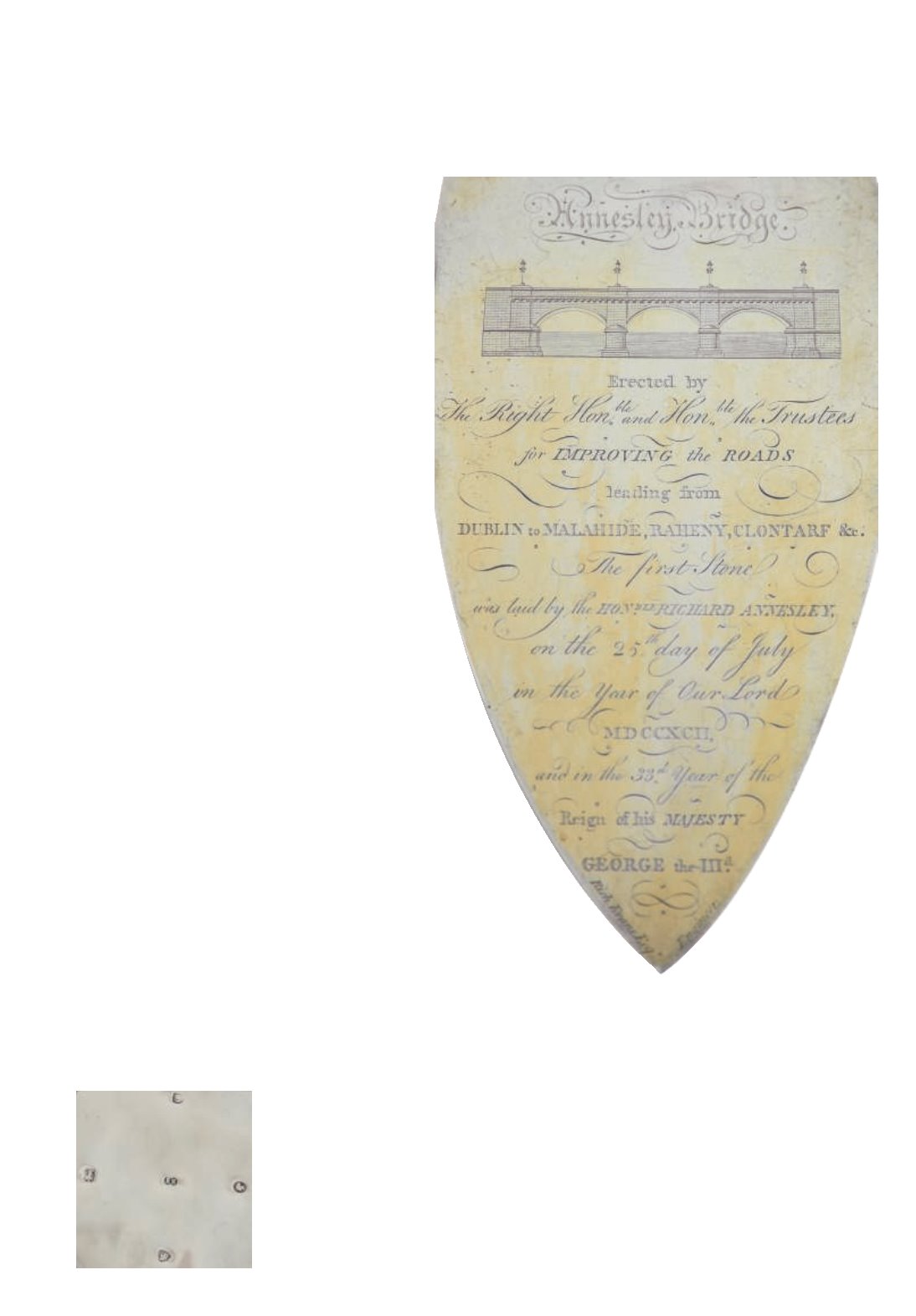
23 A HISTORIC DUBLIN SILVER-GILT PRESENTATION TROWEL, DUBLIN 1792,the blade formed as an armorial with bright cut rim, the centre
engraved with a large coat of arms, the reverse engraved with
an illustration ofAnnesley Bridge and inscribed
“Annesley Bridge
Erected byThe Right Hon’ble and Hon’ble theTrustees for Improving
the Roads leading from Dublin to Malahide,Raheny,Clontarf &c.The
first stone was laid by the Hon’ble Richard Annesley on the 25th day
of July in theYear of Our Lord MDCCXCII and in the 33d year of the
Reign of his Majesty George IIId.Rich Evans Esqr.Engineer.”
, applied
with faceted green stained ivory handle. 38cm long
Provenance:The Collection of the Late Dr KurtTicher
€ 4,000 - 6,000
Completed in 1797, theAnnesley Bridge formed an important
junction in the North Dublin Inner City, crossing over the river
Tolka and connecting the EastWall Road, North Strand Road and
Poplar Row with theAnnesley Bridge Road.
The bridge is named after the Hon RichardAnnesley, 6th Earl of
Anglesey, who was a well-established and important figure in the
development of Dublin commercial and civil life during the late
19th and early 20th Century.As well as holding a number of principal
positions including Director of the Royal Canal Company, a Commis-
sioner of Irish Excise, Irish Customs,Annesley was also an MP in the Irish
House of Commons up until theAct of Union.
Although the events atAnnesley Bridge during the 1916 Rising do not feature
prominently in the history books, ferocious fighting involving the local mem-
bers of the CitizenArmy andVolunteers took place not only on the bridge but in
the surrounding areas.While historians have found it difficult to compile accurate
figures indicating the number of those wounded and killed in the battle, there is
thought to have been a significant number of casualties, including civilians caught in the
crossfire, some in their homes.
1792:Beamish and Crawford’s‘Cork Porter Brewery’is established whenWilliam Beamish and William
Crawford purchase an existing brewery (from Edward Allen) on a site in Cramer’s Lane used for brewing
since at least the 17th century.