



 87 / 326

87
Tuesday 11th October
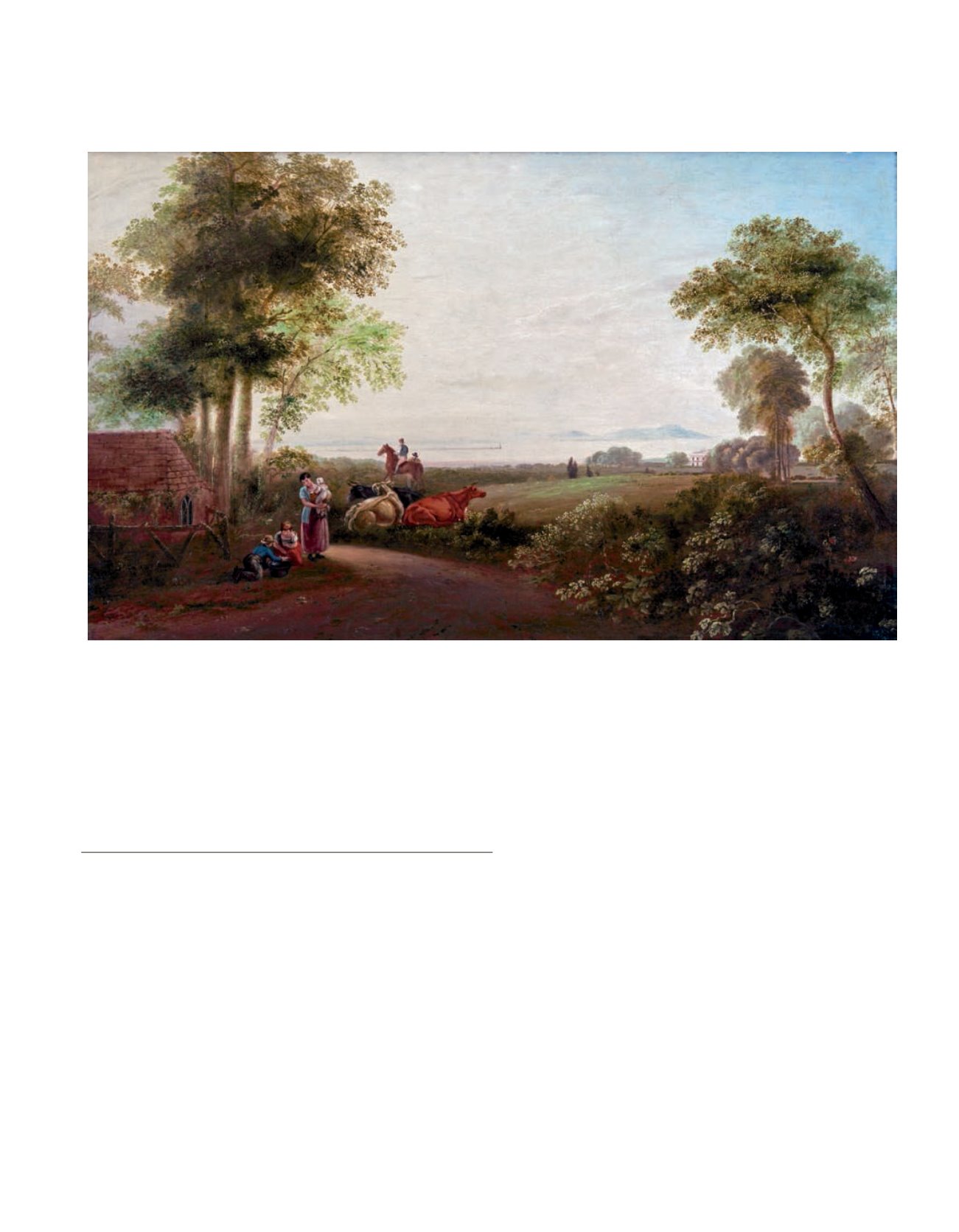
123 WILLIAM SADLER II (1782-1839)A View over Dublin Bay Looking Towards Howth, Ireland’s Eye
and Lambay Island, with Frescati in the foreground, together with
figures and animals
Oil on panel, 48 x 79cm
€ 8,000 - 12,000
William Sadler II was born about 1782 and practised in Dublin, painting chiefly small views of the environs of the city and the Wicklow countryside. Strickland
mentions that he was fond of painting conflagrations, and did many copies of the Old Masters. His works are generally small in scale and were painted on
mahogany panels, some salvaged from coach door panels.
Larger works such as the present lot are rare as are recognizable topographical views. This view of Dublin Bay from the south provides us with a panorama
ranging from Blackrock on the right over as far over as Sutton on the left. On the Blackrock shores we have a vignette of what appears to be Frescati House,
built in 1739 for the family of John Hely Hutchinson, the Provost of Trinity College. In the 1750s, Hely-Hutchinson sold the house to the FitzGeralds, Ireland’s
largest landowners, who owned land throughout Leinster. Frescati became one of their three principal residences alongside Leinster House in Dublin and
Carton House in Co. Kildare. They spent much time in Frescati, especially in the summer.
The house tripled in size and received flanking wings and bay windows to take advantage of its wonderful sea views. It was at this time that the house was
given its name, Frescati, a deliberate derivation of the Italian resort of Frascati. Sadly in more recent, less enlightened times the house was allowed decay and
it was finally demolished in 1983 to make way for a shopping centre.
The diminishing mounds of Howth, Ireland’s Eye and Lambay Island to the north and the man-made promontory that is the South Bull Wall and Poolbeg
Lighthouse are seen in the middle distance. Dublin Bay had a long-running problem with silting and held major sand banks to either side of the Liffey mouth.
Between the North and South Bulls, a sand bar existed, rising over time, limiting access to the city quays. After various ineffective efforts in the early 18th
century, a stone pier of massive granite blocks, brought from quarries at Dalkey was commenced in 1761, working from the Poolbeg Lighthouse back to shore.
It was the world’s longest sea wall at the time of its construction and remains one of the longest in Europe.
These clearly recognized points of reference are framed between stands of woodland and a charming rural family scene with cattle and horses, the kind of
idyllic farming scene long since gone in south County Dublin.