


 7 / 326

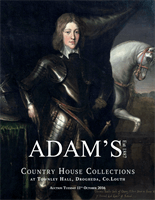
COUNTRY HOUSE COLLECTIONS AT TOWNLEY HALL 2016
For their eighth auction of Country House Collections Adam’s are moving from their ha-
bitual location, Slane Castle, to nearby Townley Hall, downstream, but happily not down-
hill.
Slane, with its astounding new distillery taking shape in the old yards, is entering a new
and exciting phase. Townley will be more bucolic, a house, not a castle, and with less like-
lihood of 80,000 hard rockers on the lawns outside. But the two are joined both by the river
Boyne and the architect Francis Johnston, who was creating the finest neo-Grecian build-
ings and monuments well before the great Schinkel of Berlin. The latter is famous, the
former unknown outside Ireland. The architectural history of Townley is well document-
ed, suffice to say Johnston and his patron, Blaney Townley Balfour created a masterpiece.
John Betjeman said he knew of no other house “so dignified, so restrained, so original”.
It is curious that three of the great domestic spaces in Ireland are so close together; the
staircase well at Townley, the Gothick ballroom at Slane and the Adams “Eating Parlour”
at Headfort.
So the offering of the present sale will be displayed in an appropriate setting and there
is much of interest. The ‘swagger’ portrait of Lord Kingsborough sprawled in his chair
encapsulates the braggadocio of 18th Century aristocratic Dublin. As a commission, the
artist would have followed the sitters instructions, so young King fancied himself as a
Hogarthian rake and copied the pose seemingly without qualms as to Hogarth’s satire. No
doubt it hung in No. 13 Henrietta Street where the craic was mighty.
The great serving table from Fort Granite, probably originating from Belan House is a
reference to another Anglo-Irish dynasty, the Earls of Aldborough, whose story is beyond
fiction. Fort Granite, itself by name, appears to conjure up a forbidding bastion guarded
by sentinels. Not at all, a fading friendly house loved by dogs and horses where full and
quiet lives were led by old sportsmen, old soldiers, old friends, often times being one and
the same. Mountainstown, a house dedicated to sport and the picture of Mr Pollock and
the Meath Hunt of 1846 could not be further removed from the reality of mid-19th Centu-
ry Ireland. It represents a sporting idyll but perhaps not a callous one. After all the horse
transcended in Ireland, and still does, all politics, religion and social divides.
There is much to tempt here from simple Irish mahogany furniture to Regency sophis-
tication, rare guns, good Irish glass, portraits, old master paintings, Swiss views etc. all
surveyed by the busts of the Vere Hunt family of Curraghchase, beloved by poets, burnt,
but perhaps something of the memories of such houses can be evoked by the present sale
in the entrancing setting devised by Francis Johnston at Townley Hall, even if the stage
hands are but grubby auctioneers.
N.N.