


 40 / 326


40
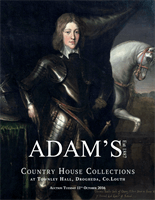
45 ATTRIBUTED TO SIR ANTHONY VAN DYKEPortrait of Thomas Butler, Earl of Ossory, Eldest son of James,
Duke of Ormond, in armour standing near his charge
Oil on canvas, 208 x 116cm
Provenance: Formerly in the collection of the Earl of Fitzwilliam, 1948
€ 10,000 - 15,000
Thomas Butler, 6th Earl of Ossory, (1634 –1680) was born at Kilken-
ny Castle, the eldest son of James Butler, 1st Duke of Ormonde
and Lady Elizabeth Preston.
His early years were spent in Ireland and France. He was an
accomplished athlete and a good scholar. In 1661 Butler became
a member of both the English and the Irish Houses of Commons,
representing Bristol in the former and Dublin University in the
latter House. In 1665 he was appointed lieutenant-general of the
army in Ireland and in 1666 was created an English peer as Lord
Butler.
Having proven himself as an expert military strategist, and whilst
visiting France in 1672, he rejected the liberal offers made by Louis
XIV to induce him to enter the service of France, and returning to
England he added to his high reputation by his conduct during the
Battle of Texel in August 1673. From 1677 until 1679, he served
alongside his father as a Lord of the Admiralty.
The earl was close to William, prince of Orange, and in 1677 he
joined the allied army in the Netherlands, commanding the British
section and winning great fame at the siege of Mons in 1678. He
acted as deputy for his father, who was lord-lieutenant of Ireland,
and in parliament he defended Ormonde’s Irish administration
with great vigour. In 1680 he was appointed governor of English
Tangier, but his death prevented him from taking up his new
duties.
Ossory had eleven children, including James Butler who became
the 2nd Duke of Ormonde in 1688. A portrait of Thomas Butler by
Lely, painted in 1678 is in the National Portrait Gallery, London and
a portrait by the same hand of his father, the 1st Duke is in the
ownership of the National Trust at Kedleston Hall.