



 253 / 326

Tuesday 11th October
253
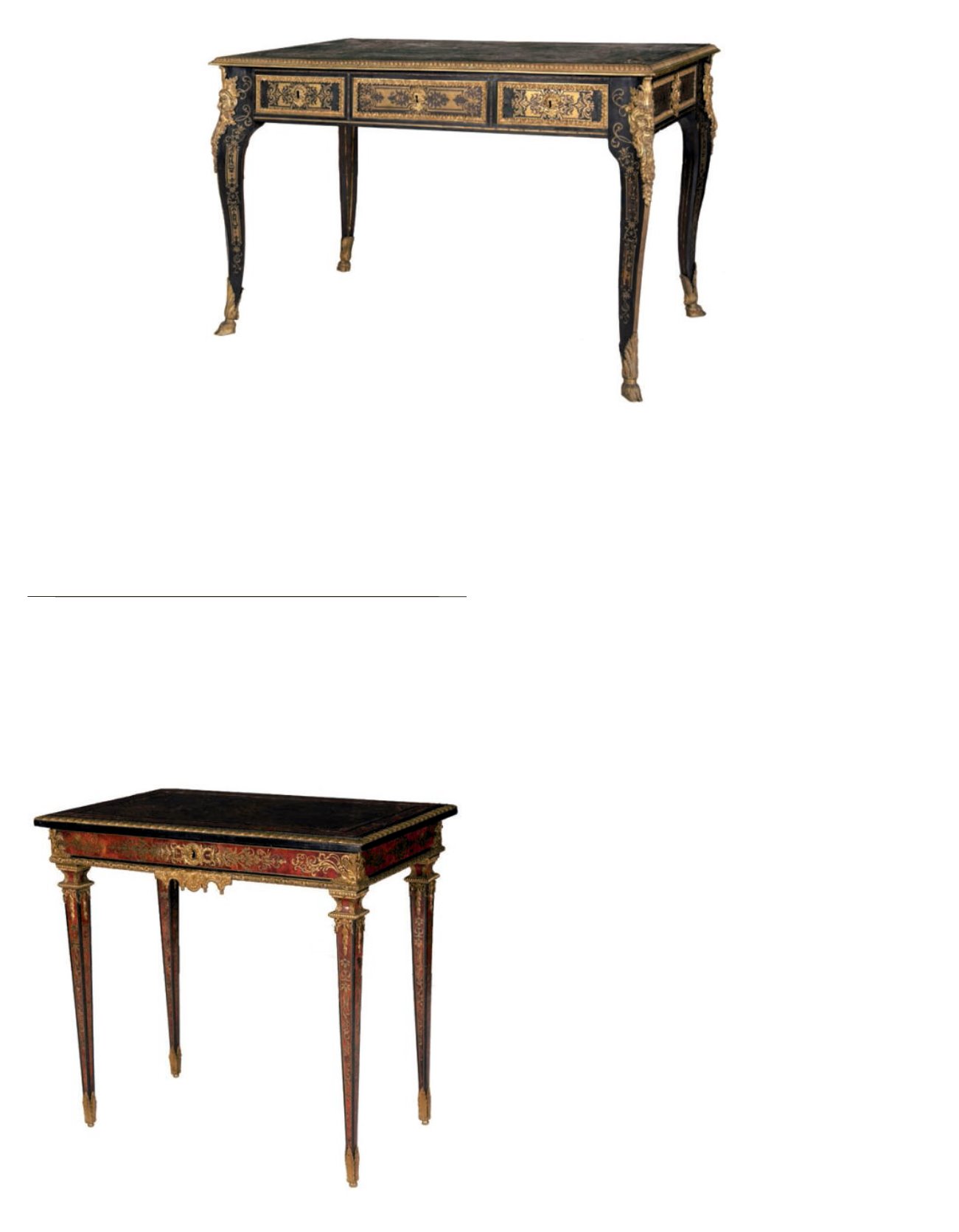
430 AN 18TH CENTURY INLAID BOULLE BUREAU PLAT,of rectangular form, the ebon ground decorated profusely with
brass inlay of scrolls, anthemion and acanthus leaves within a cast
egg and dart boarder, above a frieze with three drawers, raised on
slender cabriole legs, with cast mask capitals and hoof sabots. 122
x 74cm
€ 4,000 - 6,000
431 AN 18TH CENTURY FRENCH RED BOULLE WRITING TABLE,by Vitel, the top with inset leather scriber within a cast egg and dart banding,
decorated with panels of faux tortoiseshell and brass inlay with side frieze
drawer raised on square tapering legs, 82 x 49cm
Identical to the lot Sold by Christie, Manson & Woods, London. Property of
Major-General Sir George Burns, North Mymms Park, 24th September 1979, Lot
296
Jack Bailey Collection, Gloucestershire, England
That gilt-bronze and boulle-mounted writing table previously formed part of
the great collection at North Mymms Park, Hatfield, Hertfordshire. Built at the
end of the 16th century, the estate was purchased in the early 1890s by Walter
Hayes Burns, brother-in-law of J.P. Morgan, who made modifications to the
house to accommodate the his growing collection of art and furniture. The table
stood in the library before being sold in 1979 by Walter’s son, Major-General
Sir George Burns, a decorated British army officer and president of the North
Mymms Cricket Club for over sixty years.
Boulle marquetry, the technique of inlay in brass and tortoiseshell, had been
perfected in France by the celebrated ébéniste to Louis XIV André Charles Boulle
(1642 -1732), and its use continued throughout the eighteenth century on some
of the finest French furniture. André Roubo’s L’Art du Menuisier, published in
Paris in 1775, offers the most detailed account of the method Boulle and his
followers used. He described how the preferred tortoise-shell was in fact that of
a turtle from the seas around the island of Quimbo. The shell was prepared for
cutting by a complex process of boiling it, clamping it into moulds and polishing
one side whilst continually watching for shrinkage. The shell, together with the
brass and pewter inlay was then cut after a tracing, the three combining to
produce the elaborate designs which characterize such work.
The present table is executed in contre partie and stamped VITEL. He is record-
ed as a manufacturer of furniture in boulle marquetry, guilloche mouldings
and ormolu mounts, as well as a restorer of objects of art and curiosity. In 1838
Vitel had premises at 30 rue Saint-Jean-de-Beauvais, followed by 37 rue de la
Montagne-Sainte Geneviève in 1840-41, and finally at 17 rue des Fossés-Saint
Vicor until 1864.1
Rather than being a slavish copy of a table in an earlier style, Vitel has created,
by a fusion of Louis XVI-inspired neoclassical elegance and Louis XIV period
baroque detailing, a table of notable originality and presence. Such creations
were extremely popular in the first part of the 19th century among the British
aristocracy and collectors such as George IV, William Beckford and George
Watson Taylor. The fact that it formed part of such a notable patrician English
collection leads one to speculate that it was a custom Parisian piece for the
English market.
Footnotes:
1. Ledoux-Lebard, Denise. Les Ébénistes Parisiens Du Xixe Siècle. 1795-1870.
Leurs Œuvres Et Leurs Marques, Etc. (seconde Édition Revue, Corrigée Et Con-
sidérablement Étendue.). pl. CXXVIII. Paris, 1965, 1965. 550.
€ 4,000 - 6,000