



 193 / 326

Tuesday 11th October
193
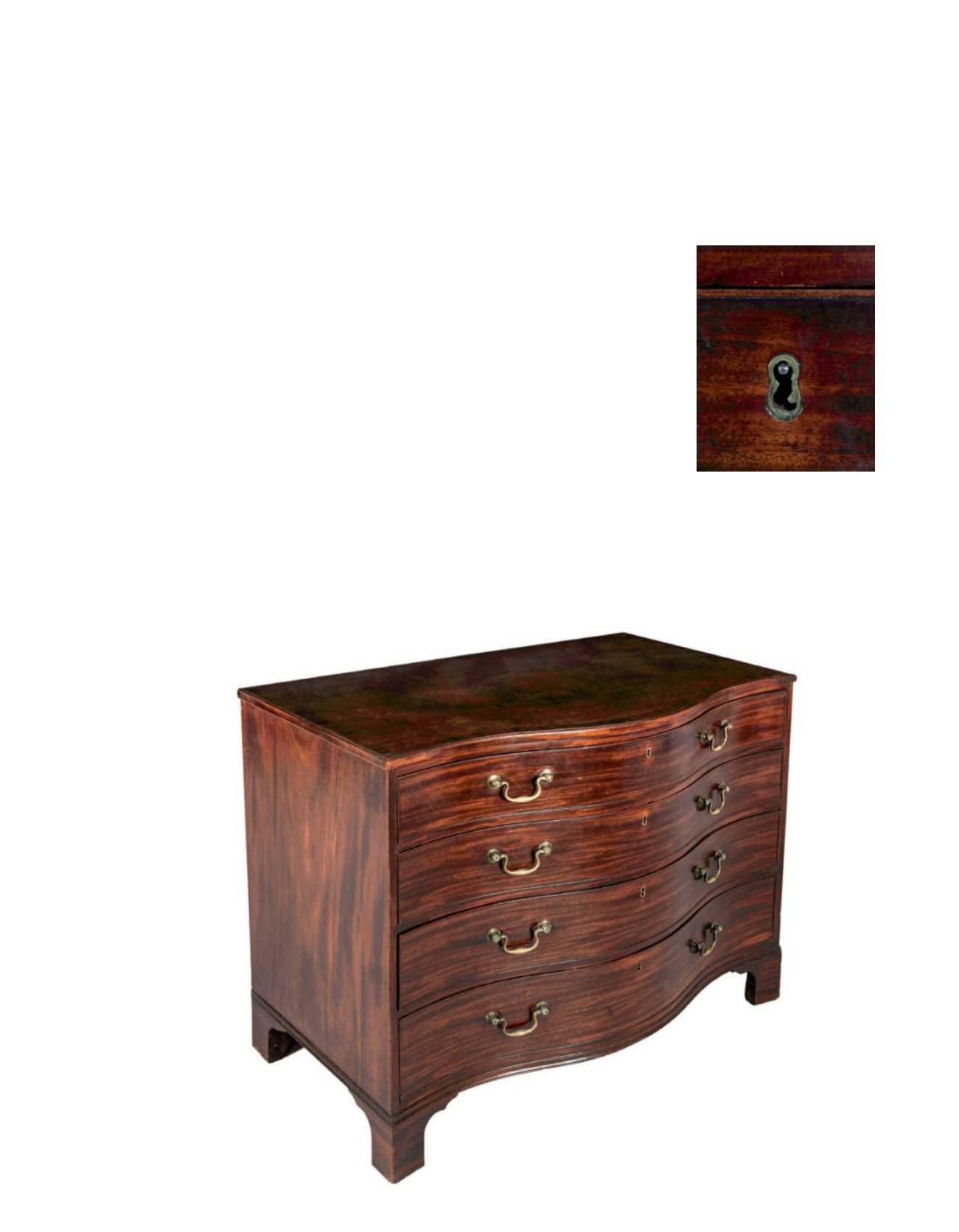
297 A FINE GEORGE III CHIPPENDALE PATTERN MAHOGANY SERPENTINE FRONT CHEST,the plain top above four long graduated cockbeaded drawers with brass drop handles and fitted
‘S’ shaped escutcheons and raised on bracket feet. The underside has a thin red wash applied.
The thin red wash appeared on a number of pieces of mahogany furniture at Dumfries House, Ayr-
shire, which were attributed to ‘The Dumfries House Cabinet-Maker’ - possibly Thomas Chippendale
(included in the Dumfries House Christie’s sale catalogue, 12-13 July 2007, among them lots 106,
236, 251 and 252). Rufus Bird highlights each of the chests examined have a distinctive ‘thin red
wash’ painted on the underside and sometimes on the backboard, similar to the lot offered here
(Bird, R. Ibid, Volume II, p.9). The wash is seen on many lesser pieces of Chippendale furniture in
the house and also on the magnificent Padouk bookcase. At Nostell Priory Chippendale wrote to
Sir Ronald Winn in August 1767 regarding ‘the bottle of red stain for the medal case’ and instructed
him to apply the stain two or three times to ensure depth of colour (Royton, L. and Goodison, N.,
Thomas Chippendale at Nostell Priory, Furniture History, 1968, p.21)
The distinctive S-pattern keyhole is a feature used nearly exclusively by Thomas Chippendale,
although only occasionally recorded on furniture by his competitor John Cobb. According to Gilbert
it was noted that a number of documented cabinet pieces by Chippendale are fitted with S-shaped
key-hole openings. The S-shaped keyholes appear most notably on the bookcases supplied by
Chippendale around 1772 to Sir Penistone Lamb for the Library at Brocket Hall (Christopher Gilbert,
The Life and Work of Thomas Chippendale, 1978, vol. II, figs. 77, 80 and 267). In his 1768 account to
Lady Shelbourne, Chippendale mentioned that a commode table had ‘very good spring and tumbler
locks and S-bitted keys’, as Gilbert remarks, this hardly justifies talk of a special ‘Chippendale key-
hole’ it confirms he employed the pattern’ (C. Gilbert, The Life and Work of Thomas Chippendale,
vol. I, p.253). A serpentine chest attributed to Chippendale sold anonymously, Christie’s, London,
25 November 2004, lot 79 featured ‘S-pattern’ keyholes, which were favoured by Chippendale and
were a speciality of the Gascoigne family of St. James’s. This lock pattern has very occasionally been
recorded on furniture attributed to Chippendale’s competitor John Cobb, for example on the com-
mode sold anonymously, Christie’s, New York, 19 April 2001, lot 148. However, nearly all occurrenc-
es are on furniture attributed to Chippendale.
€ 8,000 - 10,000