



 167 / 326

167
Tuesday 11th October
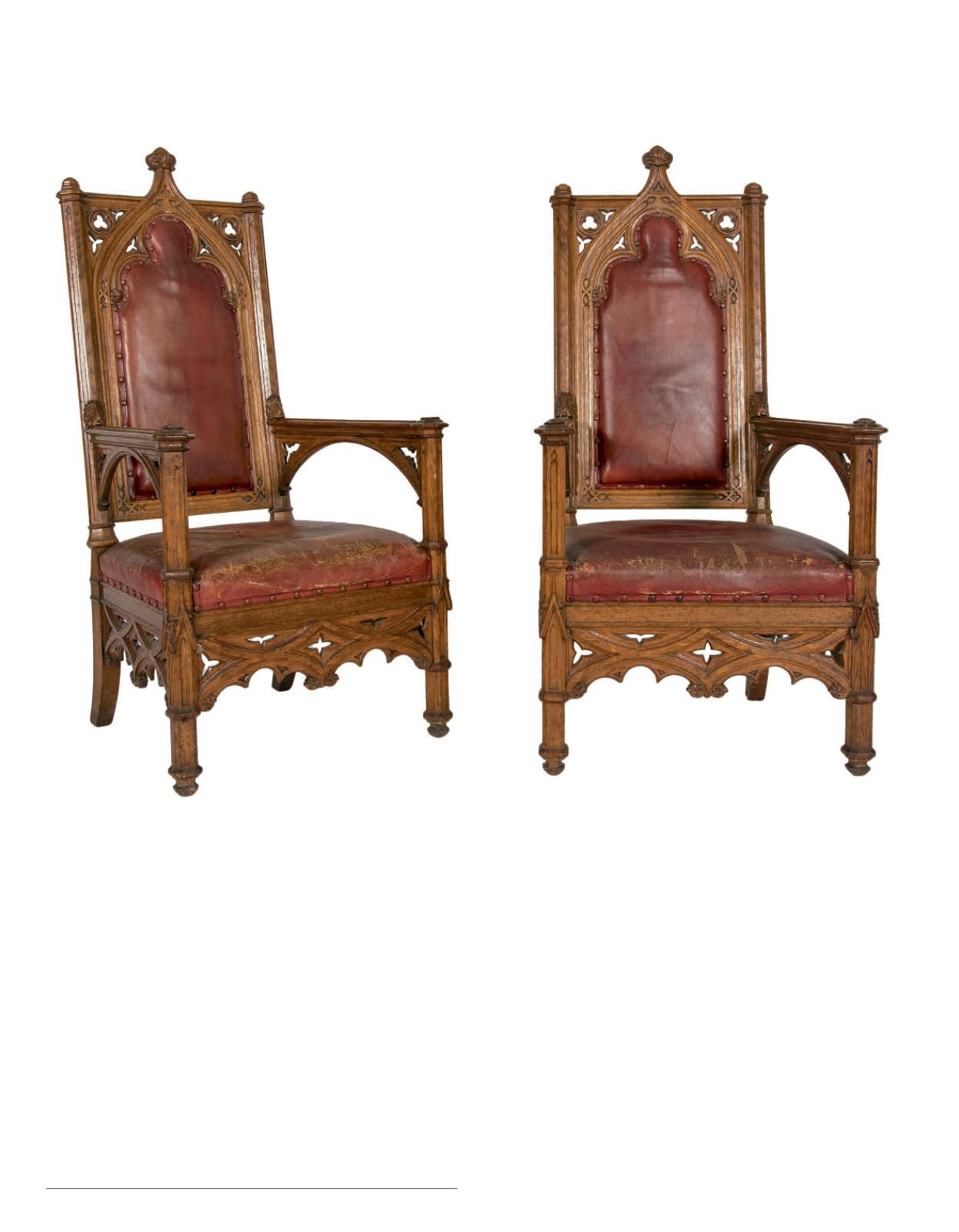
250 A FINE PAIR OF EARLY 19TH CENTURY CARVED OAK GOTHIC HALL CHAIRS ATTRIBUTED TO JOSEPH PIERRE FRANCOIS JEANSELME,the backs with padded panels and covered in red hide, with similarly upholstered seat, with reeded arm supports, on octagonal col-
umns, decorated with carved pierced trefoils etc.
A similar example of these chairs can be found in The Metropolitan Museum of Art, New York, Accession Number: 1995.164
The overall design of this armchair is taken directly from elements used in Gothic architecture, as are the prominent ogee-arch back
surmounted by carved leaves and flanked by spandrels cut with trefoils, and the moulded details of the posts, arms, supports, and
legs, as well as the pierced skirt imitating tracery. The original leather upholstery has a pressed design showing a pattern of flowering
scrolls in red, rust, gold, and black (originally green); the outer back is covered with a gold-coloured silk glued over green serge.
Although the Gothic Revival is primarily associated with English tastes, the style also appeared in France during King Louis-Philippe’s
reign (1830-48). While in exile in England, Louis-Philippe developed a taste for English styles. The Gothic was also promoted by the
influential architect and theorist Eugène-Emmanuel Viollet-le-Duc, a restorer of French Gothic cathedrals.
The Jeanselme firm was founded in 1834 and within ten years had acquired the renowned furniture firm of Jacob-Desmalter. By the
middle of the century, Jeanselme had become one of the most important cabinetmakers in Paris as well as Fournisseur du Mobilier de
la Couronne (Furnisher to the Crown) under Louis-Philippe. The firm continued until 1930.
€ 6,000 - 8,000