


 134 / 326

134
The Killarney Woodwork Industry
By the middle of the 18th Century Killarney and its hinterland was emerging as a ‘tourist centre’. Early
visitors related their experiences of awesome lakes, mountains and wildlife in guidebooks and by 1853
Killarney was accessible by rail, allowing even greater numbers to reach the area. Roughly 30 years before
the arrival of the railroad, enterprising men such as Jeremiah O’Connor established factories for the pro-
duction of handcrafted souvenirs such as chessboards, snuffboxes, card cases - even jewellery.
The items were made from a variety of beautiful local timbers - arbutus, elm, ash, holly, yew, bog oak and
bog yew which grew in abundance on the mountainsides surrounding the Lakes of Killarney. Arbutus and
bog oak were used prolifically and became particular to the Killarney wares. As mementos of the area,
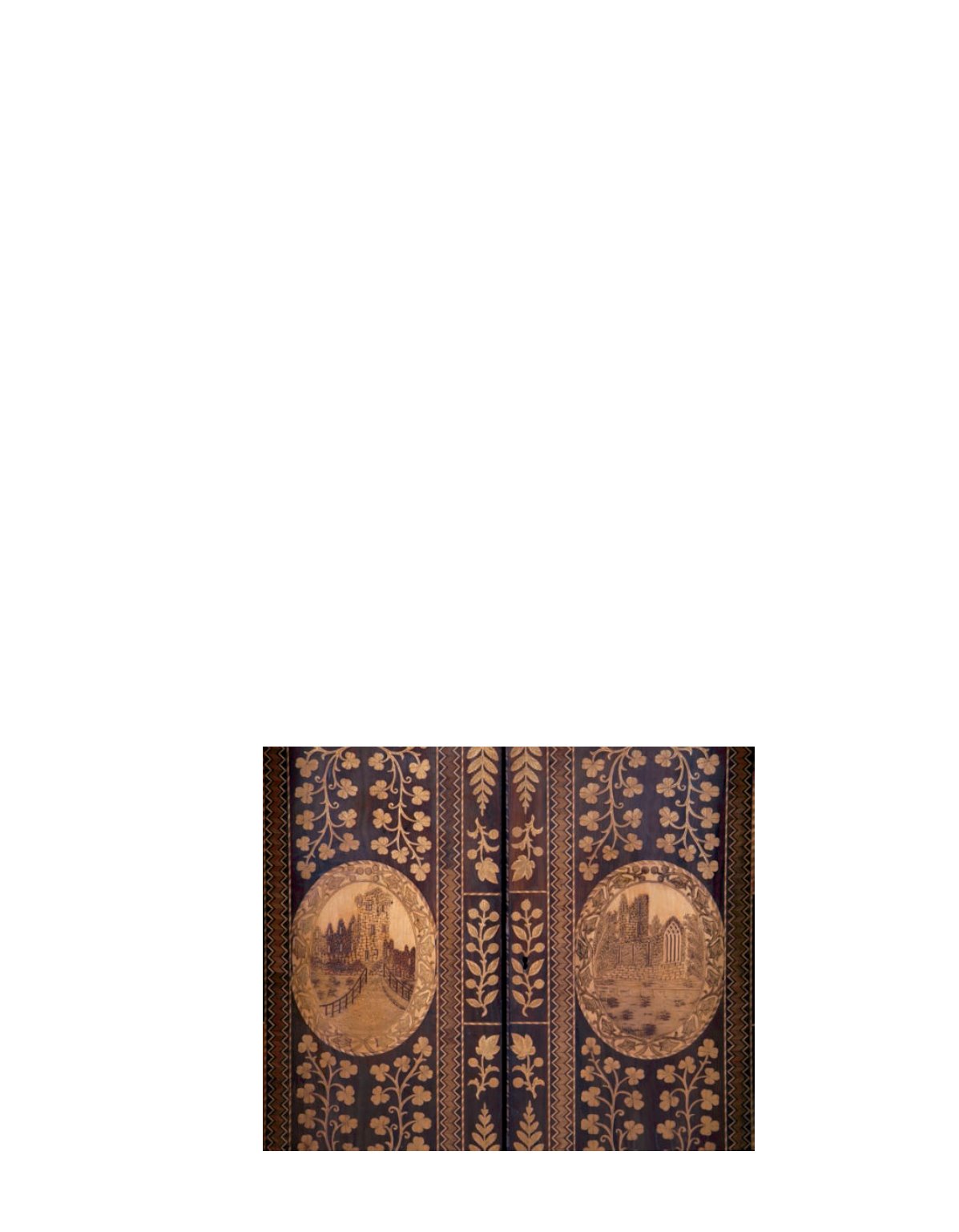
the items mentioned were inlaid with marquetry images of the most popular local sites: Muckross Abbey,
Ross Castle, Glena Cottage, Old Weir Bridge, Innisfallen, Aghadoe, Dunloe Castle and Killarney House,
several of which can be identified on the Davenport desk illustrated.
The images were largely taken from a book of engravings ‘Ireland: Its Scenery, Character &c’ (1841) by
Mr and Mrs S. C. Hall. In addition the wares were decorated with symbolic motifs of shamrock, harp, ivy,
ferns, mountain eagles and deer.
The depiction of wreaths, shamrock, rose and thistle together symbolised the union of Ireland with En-
gland, Scotland and Wales. It is possible that producers obtained the notion for such souvenir articles
from other tourist resorts such as Tunbridge Wells in Kent as there are records of similar items being
manufactured earlier than those at Killarney. The sale of these small, portable, often exquisitely carved
items was seasonal and by the mid-nineteenth century manufacturers had turned their hand at creating
fine quality pieces of furniture such as writing desks, sofas and cabinets aimed at the gentry, both locally
and nationally/internationally.
Good producers such as James Egan displayed wares at exhibitions as far away as Paris and New York.
Around 1860 Egan was commissioned by Lord Castlerosse to manufacture a fine arbutus cabinet and
desk as a gift for Queen Victoria and many of the manufacturers both gifted and sold pieces to members
of the royal family giving further status to the wares. The decline in production of Killarney woodwork
came in the late 1800s. The lack of innovation in design and competitive pricing from outside manufac-
turers assisted in the demise of the industry. The production of items in bog oak lasted longer than that
of arbutus but by the early 1900s Killarney was better known for its lace than its woodwork. Now only
woodwork museums in Kerry and the items themselves remain.