



 117 / 326

Tuesday 11th October
117
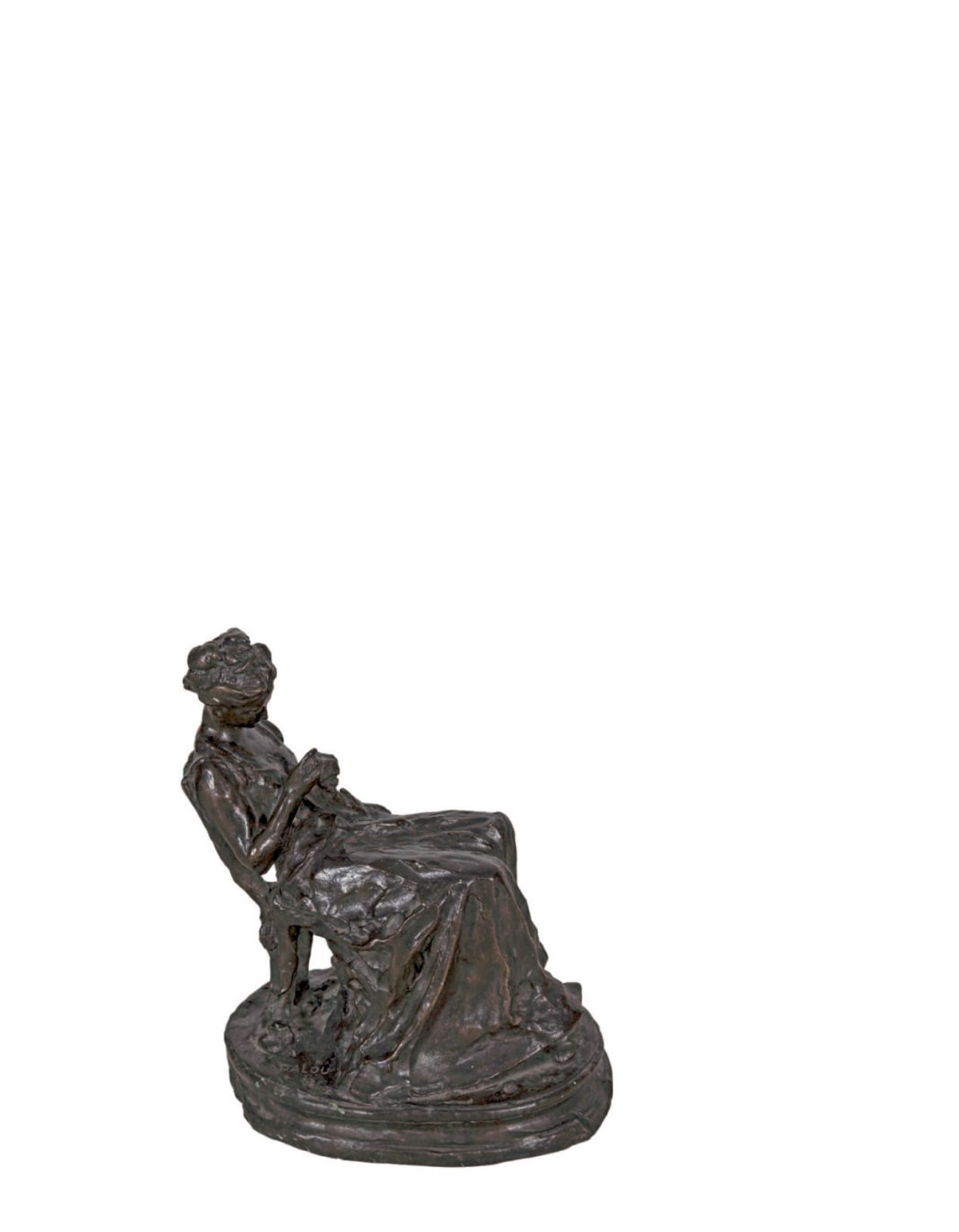
185 AIMÉ-JULES DALOU (1838 - 1902)La Brodeuse (The Embroiderer)
Bronze, 29cm high, dark brown Patina
Signed and numbered 12/12; stamped with foundry mark
‘CIRE/C.VALSUANI/PERDUE’
Provenance: Fortgranite, Co Wicklow
€ 4,000 - 6,000
Aimé-Jules Dalou was a French sculptor working in the mid-19th century amidst the country’s revolutionary politics and a rising realist style in
art. In hindsight there is a tendency to overly equate the art of this period with the contemporary political climate. However, Dalou readily es-
chewed the recognition of the academy by repeatedly refusing the Prix de Rome - a highly sought after accolade for artists at the time - despite
the fact that it guaranteed commissions. Like most nineteenth-century French artists he began his training in the École des Beaux-Arts, where
he studied for three years. His earliest works reveal the mastery of craft and design with highly detailed anatomy that would go on to character-
ize his entire oeuvre.
La Brodeuse
was made a year before he was exiled from Paris. Similar to many other artists and avant-gardes, Dalou was affected by the fall
of the Second French Empire in 1871. He relocated to London, returning to Paris in 1879 following the end of a long period of political unrest
within the Third Republic. Dalou’s career continued to grow during his exile, spending his time as a portrait sculptor, unlike other contemporary
artists such as Courbet whose reputation was destroyed following his association with revolutionary politics. Completed in 1870
La Brodeuse
was the sculptor’s first public success and lauded by critics when exhibited at the Salon in the same year. This present example is an interesting
insight into the work – stylistic and thematically – that Dalou would go on to produce for the following decade. The smaller sculptural works
such as the
La Brodeuse
express an increasing interest in the simple tasks of modern life. The main focus of the work centres on the woman’s
hands, a sense of tension which seems to imply a taught thread. Dalou’s modelling of the seated seamstress with her head bent forward
reflects an almost silent reverie at her task. Dalou’s representation of working class society always contains an element of dignity captured with
beautifully observed detail.
Dalou was a consummate draughtsman preparing preliminary sketches for his sculptural works, with this work cast after one of these large
groups of esquisses. The bronze medium cast in the lost wax process requires an incredibly high-level of skill and craftsmanship. It is also
immensely labour intensive requiring multiple individuals to create an exact replica of the original plaster cast made by the sculptor. This work
was produced by the Valsuani Foundry as indicated by their mark on the base. The company was established in 1899 by brothers Claude and
Attilio Valsuani who had learned their trade while employed at the Hebard foundry. The workshop was located in the southwestern suburbs of
Paris in commune of Chatillon, casting mostly small works for various artists primarily using the lost wax technique of casting, ‘cire perdue ’. In
1905 they relocated to a more central location on the Rue des Plantes . They cast works for artists including Renoir, Paul Troubetzkoy, Matisse,
and Gaugin. Claude Valsuani died in 1923 in his native Italy but his son, Marcele took over the running of the foundry and continued to produce
extremely fine detailed bronzes until the 1970’s.