


 57 / 164

57
Silver from the Collection of Jimmy Weldon
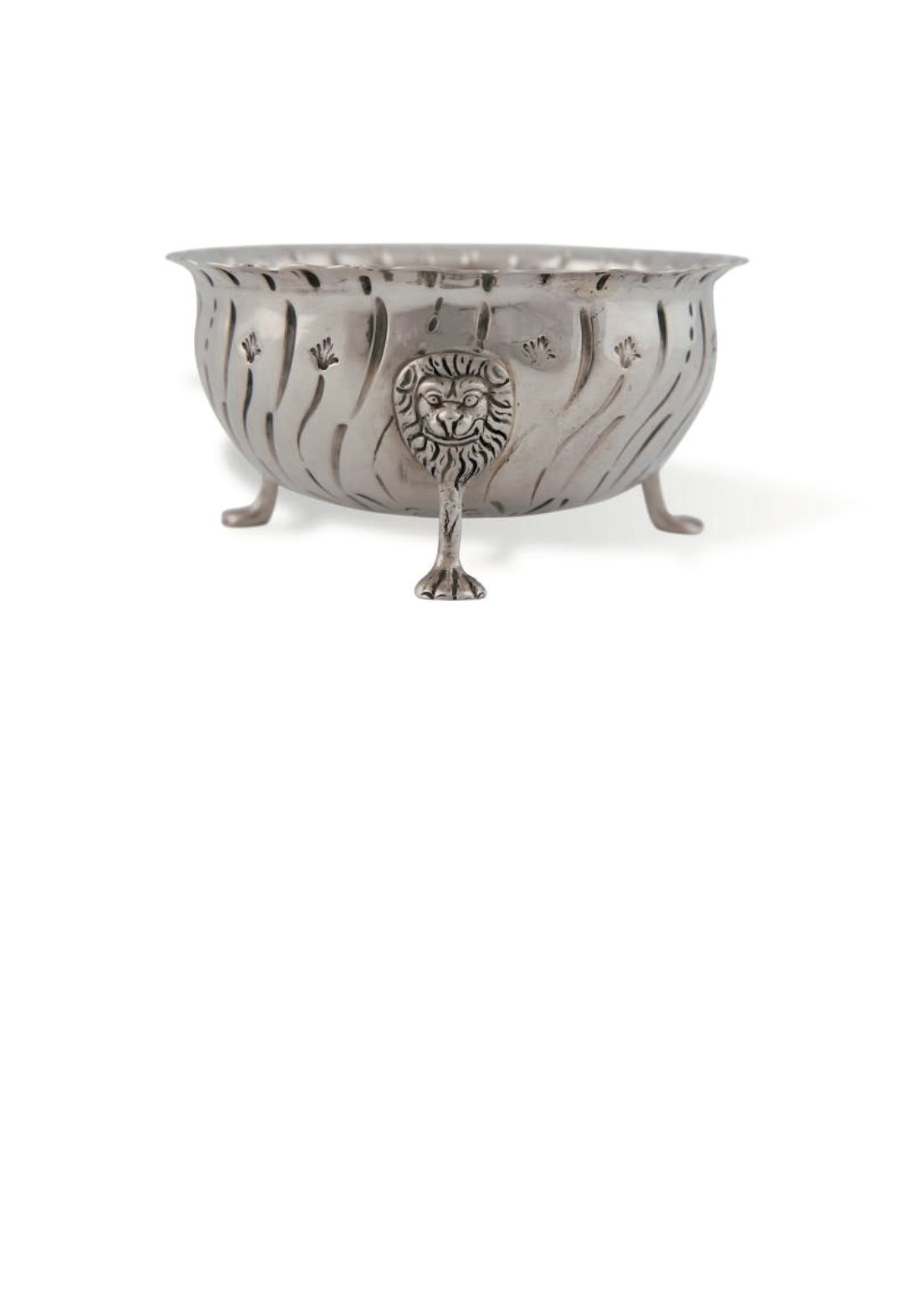
52 AN IRISH PROVINCIAL SUGAR BOWL, LIMERICK C.1770, MARK OF GEORGE MOORE,the fluted body with wavy everted rim and small leafy engraved decoration, raised on three lion mask capped paw feet, (c.217.7g).
13cm diameter
€ 3,000 - 5,000
George Moore, silversmith, obtained the freedom of Limerick in September 1748. He married Mary Foot in February 1752 in St.
Mary’s. His advertisement in the Limerick Chronicle of 11August 1768 announced that he had moved from the corner of Pump Lane
to Quay Lane, two doors below the New Printing-Office, adding that‘said Moore will take anApprentice well recommended to the
above business’.Along with other goldsmiths, he was listed as a member of theAnnuity Society of Limerick City, by the Limerick
Journal of 13 March 1769. Indicative, perhaps, of either necessity or business acumen, hisAugust 1773 advertisement in the Limerick
Chronicle showed him branching into another trade in parallel with silversmithing, announcing that he‘has lately laid in an assortment
of goods’; these mostly consisted of various kinds of luxury fabrics. He was still resident at Quay Lane when registering in Dublin in
1784 but by December 1789 his shop in Quay Lane, now named Bridge Street, had been taken over by Maurice Fitzgerald. (Bowen
and O’Brien, 2007 p202)
1770:On the 21st MarchThe College Historical Society,a debating society atTrinity College,Dublin,founded by Edmund Burke,holds its first meeting.
19th April,the same year:British explorer Captain James Cook first sights Australia.