


 21 / 164

21
Silver from the Collection of Jimmy Weldon
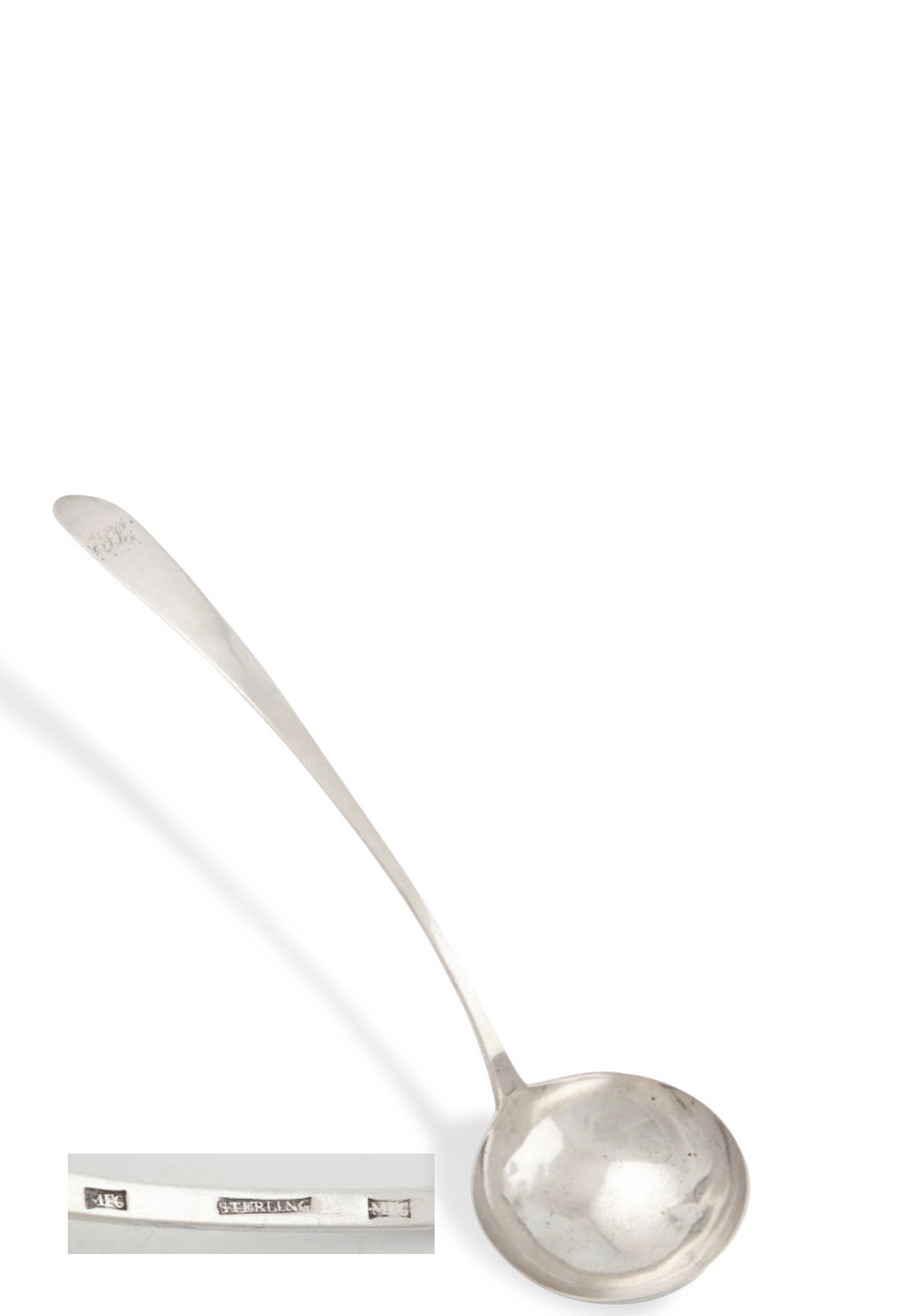
14 A RARE IRISH PROVINCIAL SILVER SOUP LADLE, LIMERICK C.1785,mark of Maurice Fitzgerald, the pointed taper handle
engraved with initials, (c.217.7g). 38cm long
€ 4,000 - 6,000
1785:On the 19 of January – Richard Crosbie successfully flies
in a hot air balloon from Ranelagh Gardens to Clontarf.He goes
on to makes several unsuccessful attempts to cross the Irish Sea in a
hydrogen-filled balloon.
Maurice
Fitzgerald, Mary
Street Limerick, working 1760-
1817. He is possibly the Maurice Fitzgerald,
son of James Fitzgerald (no address given), who
was apprenticed toVere Forster, a Dublin goldsmith in
1752. He obtained his freedom of Limerick in October 1774.
He served as bailsman in theTholsel Court in 1787 and 1789. His
advertisement in the Limerick Herald, 7 December 1789, announced his
moving‘to Bridge St (formerly Quay Lane) where Geo. Moore had his shop,
and has received from London and Dublin a fashionable assortment of silver
and plate work’. He leased part of his Rutland Street dwelling in 1815. He died in
Rutland Street in May 1817 and was buried in St. John’s; his wife predeceased him in
November 1815. (Bowen and O’Brien, 2007 p203)
Hallmarking was introduced to Ireland in 1637 in order to control the practices of
goldsmiths which had become increasingly dubious due to a lack of an established body to
monitor the craft as a whole in Ireland. King Charles I established the‘Wardens and Company
of Goldsmiths of our said City of Dublin’ with a charter that would match their counterpart
in London in relation to powers of law.The standards of production in place in England were
replicated in the assay office set up in Dublin inApril 1638 where every piece of silver produced
in the country was stamped with‘The King’s Majesty Stamp called the Harp Crowned.’A second
mandatory mark identified the maker of the item, usually the goldsmith’s initials. Or at least that
was the idea, but as with any rule there is always the exception. Limerick silversmiths managed to
defy these sanctions which mostly applied to those practicing the craft within a three mile radius of
Dublin rather than farther afield.
It was expected that those working in provincial centres would follow suit, however the specifics
were somewhat vague. Equally the physical distance and difficulty of travel in the 17th century
largely discouraged Limerick silversmiths to send their wares, of which many were highly valu-
able goods, to the assay office in Dublin.As a city, Limerick had their own trade guilds with their
own set of rules, whose privileged position created a monopoly over the commercial economy
of the city.The practice continued well into the 18th century despite the fact that the situa-
tion became more delicate for Irish provincial silversmiths with the introduction of a duty
tax of 6d. per ounce on all gold and silverwares wrought in Ireland.This manifest evasion
was tolerated by the State who turned a blind eye to the various unsanctioned marks.
When a Limerick silversmith struck his mark upon a piece it acted as their guarantee
to the customer.These marks vary with a castle gateway and six or eight pointed
star stamped on late 17th century items, while from 1710 onwards‘STER-
LING’ appeared along with the silversmiths initials.As‘STERLING’ is not
technically a hallmark the accompanying maker’s initials took on the
equivalent weight of an official stamp. By staking their reputation
through putting forward their own name rather than using the
relative safety of a standard mark assured by the assay
office, this suggests that Limerick silversmiths took
particular pride and confidence in the high
quality of their work.