


 42 / 272


42
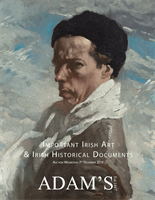
32 SIR WILLIAM ORPEN RA RWS RHA (1878-1931)Self-Portrait (1912)
Oil on canvas, 61 x 51cm (24 x 20’’)
Signed and dated 1912
Exhibited: ‘An Ireland Imagined: An exhibition of Irish Paintings and drawings 1860 - 1960’, Pyms Gallery London Oct/Nov 1993
Cat. No. 29
Literature: ‘An Ireland Imagined: An exhibition of Irish Paintings and drawings 1860 - 1960’, Pyms Gallery London 1993 Pages
50 - 52 Colour illustration Page 53
‘Smurfit Art Collection 2001’ Full page illustration Page 37
Provenance: ‘Irish Sale’ Sotheby’s London May 1996 Cat. No. 457 where purchased by current owners
There are a series of framing devices within this work of self-portraiture by Orpen. He places a painting within paintings making
reference to two of his own earlier works
The Young Man of the West,
1909, Private Collection and
The Dead Ptarmigan,
1909 Na-
tional Gallery of Ireland to which this work is almost an identical study. In each case he has chosen a more close-up format to give
a greater scrutiny to his features. If viewed as group his self-portraits crystallise his physiognomic peculiarities - you feel as if you
recognise him, it looks like him - however is this likeness subjective?
The manner in which we speak or write about self-portraiture has changed greatly since the tradition of Rembrandt. Our desire
now to associate the image of the artist with some kind of inner turmoil, an insight into their personality, emotions and fears was
previously irrelevant. A reading of Rembrandt’s self-portraits in the manner of personality and individuality was only possible after
Romantic age. The idea of the self or personhood did not exist in the 16th century, rather Rembrandt’s huge output of self-por-
traits related to the fact that the wanted to develop a strong association between his skill as a painter with his own image, thus
reinforcing the connection as artist and model.
However, elements of this thinking are still pertinent to a work such as this by Orpen, but there are some insights that we have
into Orpen’s personal life that may colour how we perceive the self-portrait. Orpen was not particularly enamoured by his physical
appearance, he was small in stature, measuring only 5ft 2in and the half-length portrait, placing his figure at the forefront of the
picture plane with little background detail which would serve to give a sense of proportion and hence his small, possibly emasculat-
ing height. Equally his large protruding lip which he doesn’t disguise in the image rather by showing himself in profile he accentu-
ates it while the dramatic lighting emphasizes the sharp angularity of the nose.
The costume he adopts a striking scarf and black beret, his furrowed brow and dark piercing eyes projects a sense of taking one-
self very seriously. The theatricality of his poses and compositions was influential for his followers in particular in the work of Sean
Keating. We are aware of his positioning looking into a mirror while painting, however it is interesting that Orpen does not include
his hands, the brush or palette in the image as identifiers of his profession, his skill - his art via his image.
We acknowledge with thanks Pyms Gallery and The Orpen Research Project whose previous writings formed the basis of this
catalogue entry.
Niamh Corcoran, November 2016
€ 100,000 - 150,000