


 90 / 170

90
In 1956, Campbell contributed three Spanish subjects to Waddington’s last group exhibition
in Dublin, ‘Thirty Years’, before Waddington closed his gallery. Campbell’s increased interest
in the rhythmic sounds of Flamenco music resulted in his works displaying rhythm and
patterns of shapes and colour. Waddington continued to channel O’Neill’s works through
his brother George’s gallery, Waddington Galleries Inc., in Montreal, Canada. Dillon was
represented by Leo Smith at the Dawson Gallery and Campbell by David Hendriks at the
Ritchie Hendriks
122
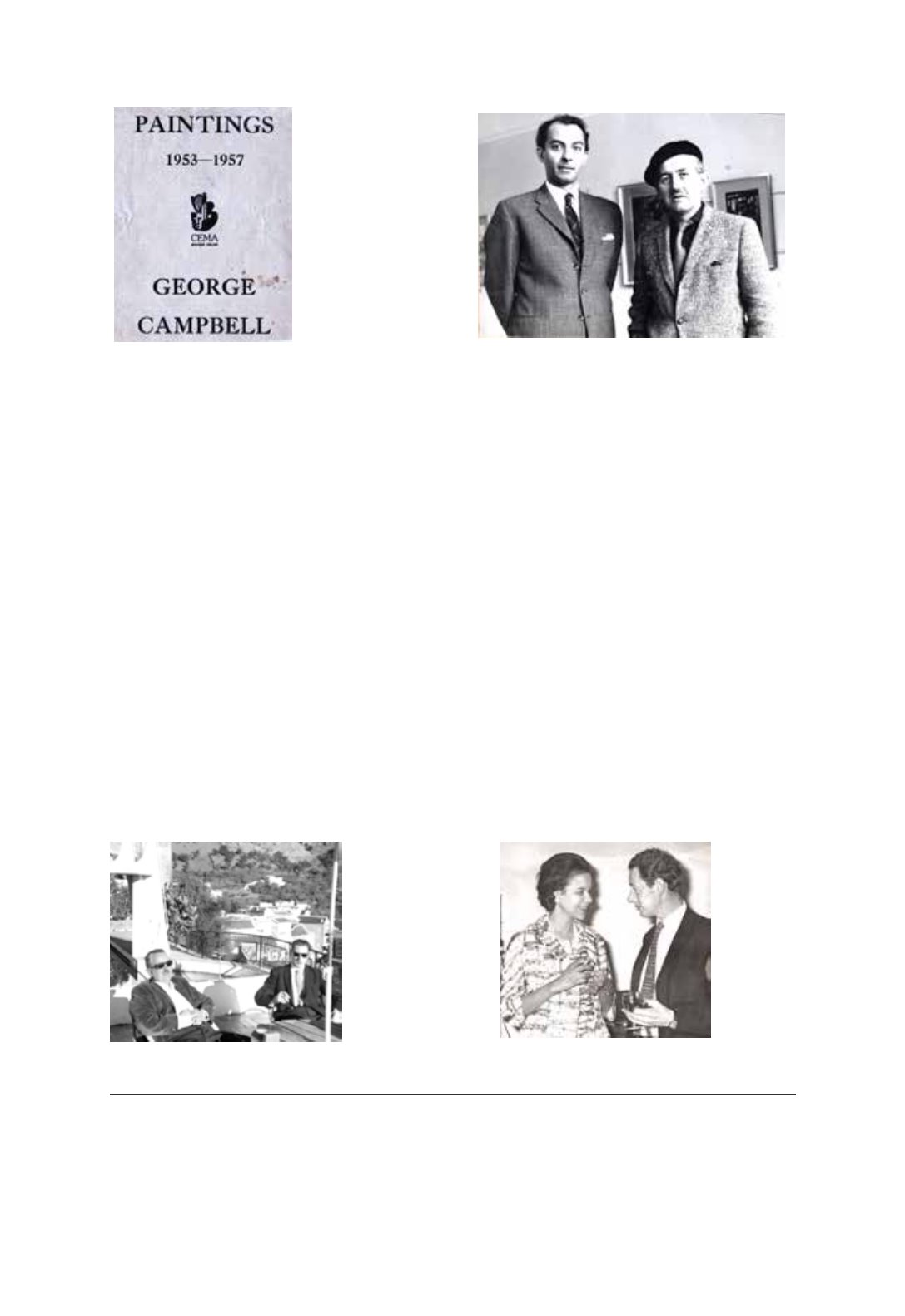
gallery, where Campbell held his first solo show in 1957, titled ‘Paintings
from 1953–57’.
123
A former assistant to Waddington, Leo Smith, worked in association with
Waddington in London to show Daniel O’Neill at his gallery in Dublin in 1960 and 1963.
Armstrong was involved in the IELA from 1957. He had a solo show at CEMA in 1956
and continued to contribute to group shows at the Piccolo Gallery, Belfast, which opened
in 1957. Initially, he lived with Dillon at Abbey Road, while working for the Civil Service
1958/59.
124
He participated in the group exhibition, ‘Northern Ireland Painters’, in 1960,
125
and ‘Europe 1962’, at the New Vision Gallery, London.
122
The gallery was renamed David Hendriks Gallery in 1969.
123
Eric Newton wrote the foreword. Campbell continued to include forewords from writers/poets for his solo
exhibition catalogues
124
Letter from Arthur’s sister, Dorothy Sinclair, to Howard Greenway, 4 September 1997.
125
Opening in Harrogate, the exhibition travelled to Reading, Battersea, Gateshead, Guildford, Nottingham,
Southgate, Southend and West Hartlepool.
fig.137: CEMA catalogue of George
Campbell’s paintings, 1957
fig.138: David Hendriks and George Campbell,
1960’s
fig.139: George Campbell and Arthur
Armstrong, Malaga, 1960’s
fig.140: Viviette Hendriks and Arthur
Armstrong