


 72 / 164

72
T
uesday
16
th
M
ay
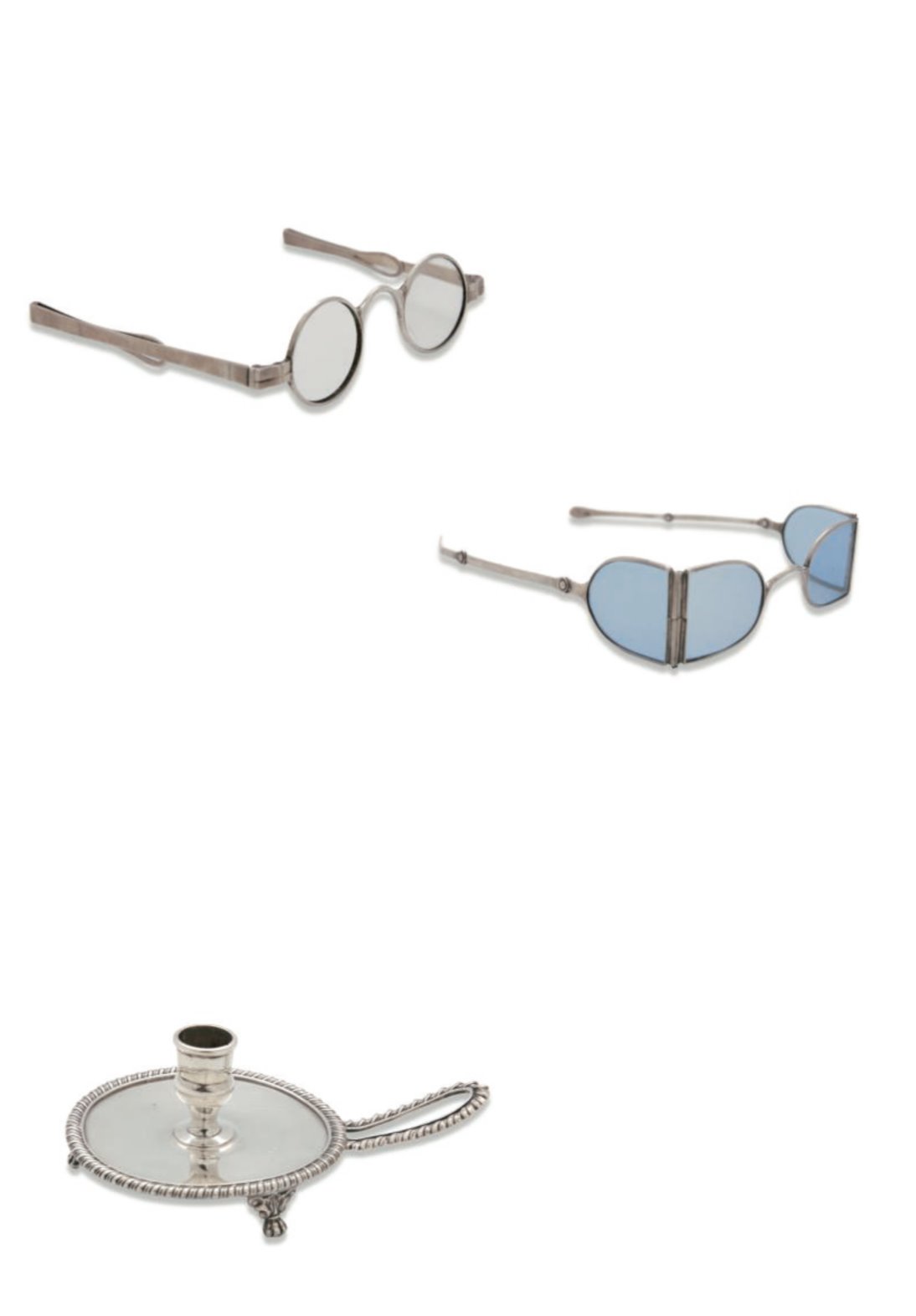
70 A PAIR OF WILLIAM IV SILVER FOLDING SPECTACLES, BIRMINGHAM 1832,mark possibly that
of John Guest, with extending fold-out arms, fitted with four angled
blue tinted lenses, joined by an arched bridge. 10.5cm wide
€ 150 - 250
69 A PAIR OF LATE GEORGIAN OVAL SILVER FRAMED SPECTACLES, C.1800,fitted with clear circular lens and extending fold-out wrap-around
arms ending with pierced tear-drop loop. 12cm wide
€ 100 - 200
71 A GEORGE III CHAMBER CANDLESTICK, LONDON 1813,mark of Joseph Craddock &William Ker Reid, the circular body
with gadrooned rim and open handle, on three leaf capped paw
feet, (c.233g). 18cm wide over handles
€ 300 - 500
1813:A Cholera Epidemic breaks out in Ireland killing 30,000 people
The start of the 18th century brought about the advent of readily available and affordable newspapers, the first successful paper in Britain being
published in 1702.This led to an increase in the literate population reading outside of the home and commanded a greater demand for portable
eyewear. For this reason, we see an explosion of technological development in spectacles at this time, with sides being added at some stage before
1730. Improvements were also made to the actual lenses. Previously, two options were available to the customer: glasses for‘young eyes’ and
glasses for‘old eyes’.As would be expected, this didn’t fully satisfy everyone’s needs and, thus, spectacles of varying strengths were developed, the
‘prescription’ sometimes being noted on the sides.Whilst our pair does not show this, they do bear the characteristic round rims that were popular
at the time.
In contrast are the more unusual angular rims that house the tinted lenses seen here. Ever at the height of fashion and wealth,Venice can lay claim to
the invention of modern day sunglasses, their predecessors being of similar form to these.With a constant glare of light bouncing from the lagoon
and radiating throughout the city, the coloured glass was adopted to protect one’s eyes from this discomfort.