


 90 / 310

90
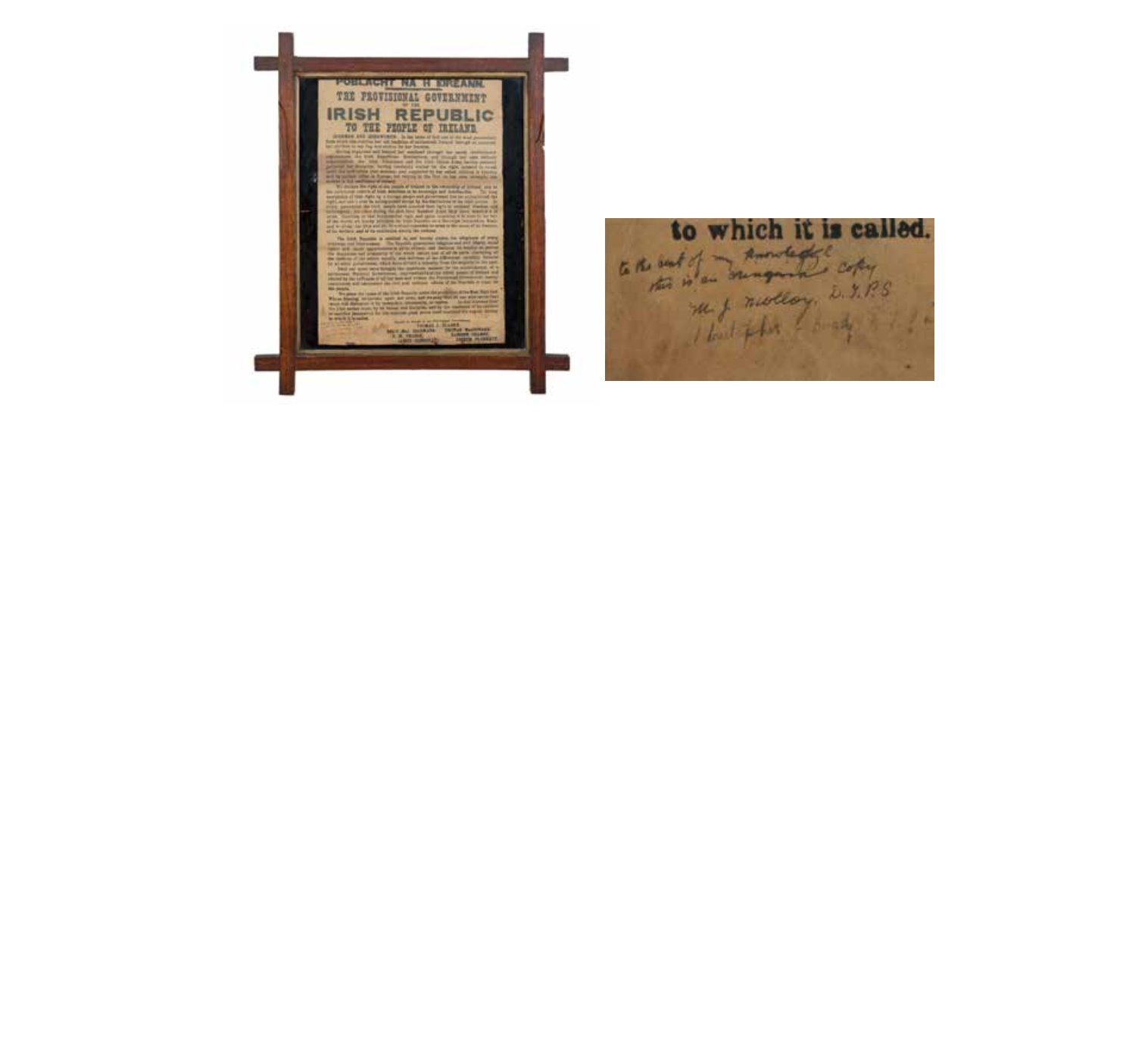
99 1916 PROCLAMATION:THE VERY RARE 1917 ISSUE. POBLACHT NA H EIREANN. The Provisional Government of the IRISH REPUBLIC to the People of Ireland ..
A printed copy of the 1916 Proclamation, similar in most respects to the original issue, but with some points of difference, notably
a. Eamonn Ceannt’s Christian name is mis-spelled EANONN;
b. The inverted ‘e’ in original is here corrected [last paragraph, first line, ‘under the protection’];
c. The capital ‘E’ in ‘THE’, line 5, is a genuine ‘E’, whereas in the original it is an ‘F’ with a tail added;
d. Length of printed line (i.e. length of forme) is 17 ½ ins (l8 ¼ ins in original).
e. Other typographical peculiaries have been reproduced as in original.
These features are all consistent with the description of the 1917 issue in Bouch’s paper [1936, p. 51]. They are not consistent with any other known issue.
The size of the paper is approx. 29 ½ x 20 ins, which again is consistent with Bouch if the sheet has been slightly trimmed. It is poor quality poster-paper, lighter than the
paper of the original, and very fragile.
Bouch explains that this issue was commissioned by a group of women attached to the Irish Citizen Army, who wished to mark the first anniversary of the Rising. As much
as possible of the original type-stock was assembled, and the document was printed on Good Friday and Saturday by Mr. Walker (senior) and his son Mr. Frank Walker,
employees of Joseph Stanley’s Gaelic Press. Bouch says 1,000 copies were printed, and many were pasted up around Dublin in the principal streets. They were of course
quickly removed by the police.
It is a very rare document, inherently even more fragile than the original. In 1936 Bouch was able to examine eight copies of the original, but he found only one copy of
the 1917 issue. There is a copy in the Clarke archive in Mayo, said to be the one seen by Bouch. We are not aware of any other copy extant; there is none in the National
Museum. No copy has appeared at auction in recent years.
Bizarrely, the present copy is endorsed in ink at foot by M.J. Molloy and Christopher Brady, compositor and printer of the original document, under the statement ‘To the
best of my knowledge / this is an original copy’. Molloy and Brady did not print the 1917 document, so they must be certifying it here as a 1916 original. If so, they are
clearly mistaken.
Condition: light fold marks, a little dusty in places, generally very good considering its age and the paper quality.
Provenance: Patrick J O’Leary born 1898 at No. 2 Morgan Place later subsumed into the Four Courts. Joined 1st Battalion Irish Volunteers in Jan. 1916. After the Rising, he was brought
to Ship St. Barracks thence to Richmond Barracks and deported to Stafford Jail on 8th May. Sent to Frongoch internment camp and released in November 1916. On return he assisted
Countess Markievicz in distributing aid to the poor of Dublin. Family information is that he was given the copy by the Countess herself and it hung along with his medals in the hallway
in 33 East Essex St. until the house was sold in the 80’s.
€ 30,000 - 50,000