


 173 / 310

173
www.adams.ieThe History Sale 19
th
April 2016
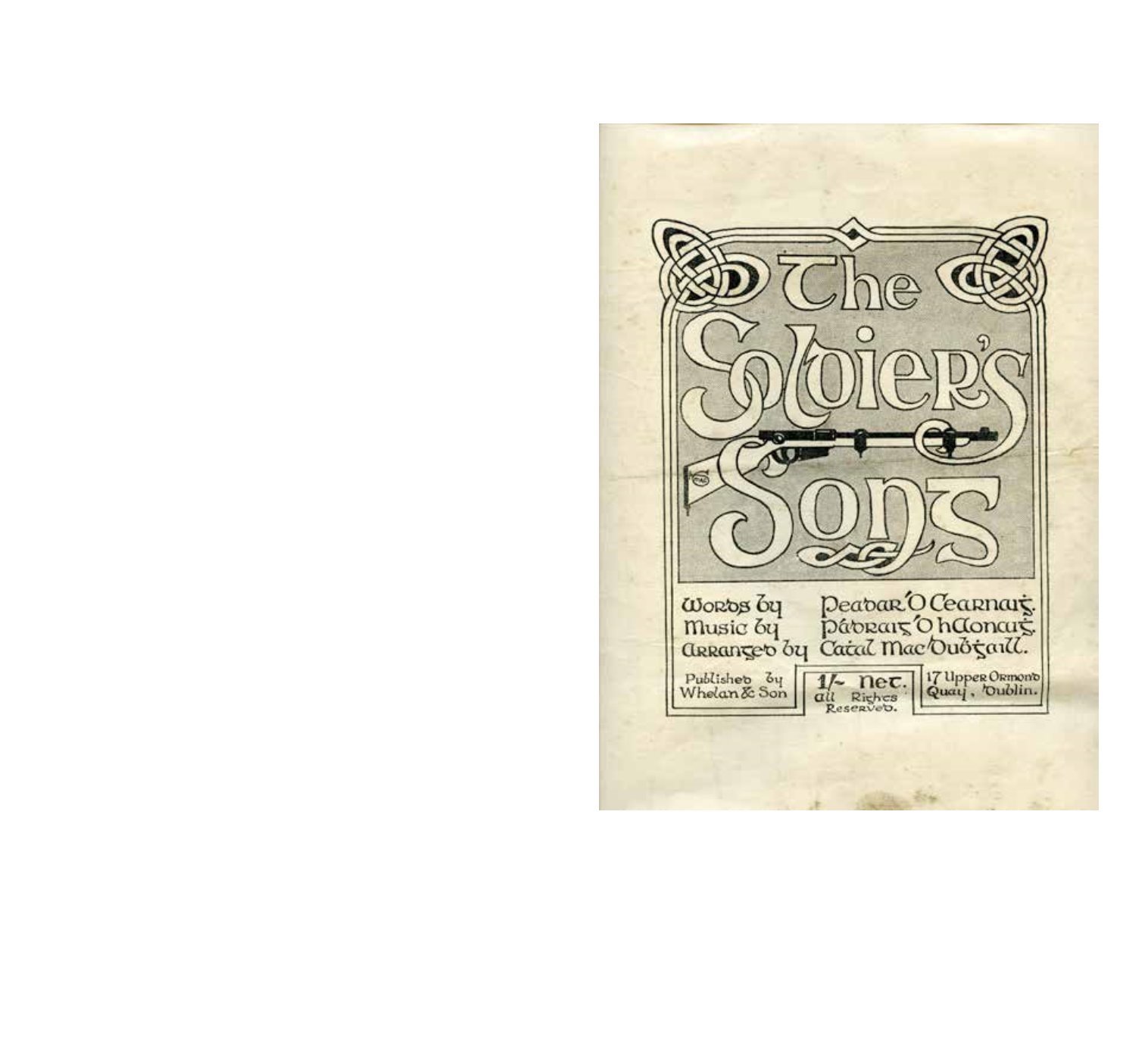
217 KEARNEY (PEADAR), THE SOLDIER’S SONG FIRST EDITION WITH MUSICFour printed pages, in two parts, 31 x 24cm approx.. Written in 1909-1910 by Peadar
Kearney, music by Paddy Heaney and arrangement by Cathal MacDubhgall. Later to
become “Amhrán na bhFiann” when it was translated to the Irish by Liam Ó Rinn in 1923.
Becoming the official Irish national anthem in 1926 following some debate about various
alternatives. Peader Kearney was a founder member of the Irish Volunteers and The
Soldier’s Song was sung in the GPO during the Rising and was popular among the Volun-
teers. As a result, later that same year (in December) it was published by Whelan and Son,
Dublin, 6. Seamus Whelan was a sympathiser. The printer was Patrick Mahon of Yarnhall
Street, who had also supplied some type for the printing of the 1916 Proclamation. The
cover design, with rifle butt signed in a stylised C.macD., is by Cathal Mac Dúbhghaill. The
first edition to include the music is rare and being sold not only on the 100th anniversary
of the Rising, but also the anniversary of the document itself.
Peadar Kearney joined the Irish Republican Brotherhood in the early 1903, and became a
member of its Supreme Council. He served in the Jacob’s Factory garrison under Thomas
MacDonagh during the rising. He evaded capture but was arrested during the War of
Independence and interned at Ballykinler Camp in County Down in 1920-21. In the Dáil
debate preceding the original acquisition of copyright by the State in 1934, there was
discussion of the song’s merits and flaws. Frank MacDermot said, “Leaving out sentiment,
I must confess, from both a literary and a musical point of view, I would regard the
“Soldier’s Song” as, shall we say, a jaunty little piece of vulgarity, and I think we could have
done a lot better.”]Thomas F. O’Higgins responded, “National Anthems come about, not
because of the suitability of the particular words or notes, but because they are adopted
generally by the nation. That is exactly how the “Soldiers’ Song” became a National An-
them in this country. It happened to be the Anthem on the lips of the people when they
came into their own and when the outsiders evacuated the country and left the insiders
here to make the best or the worst of the country. It was adopted by the people here
before ever it was adopted by the Executive Council”
€ 1,500 - 2,000