


 28 / 100

28
Tuesday 18th October
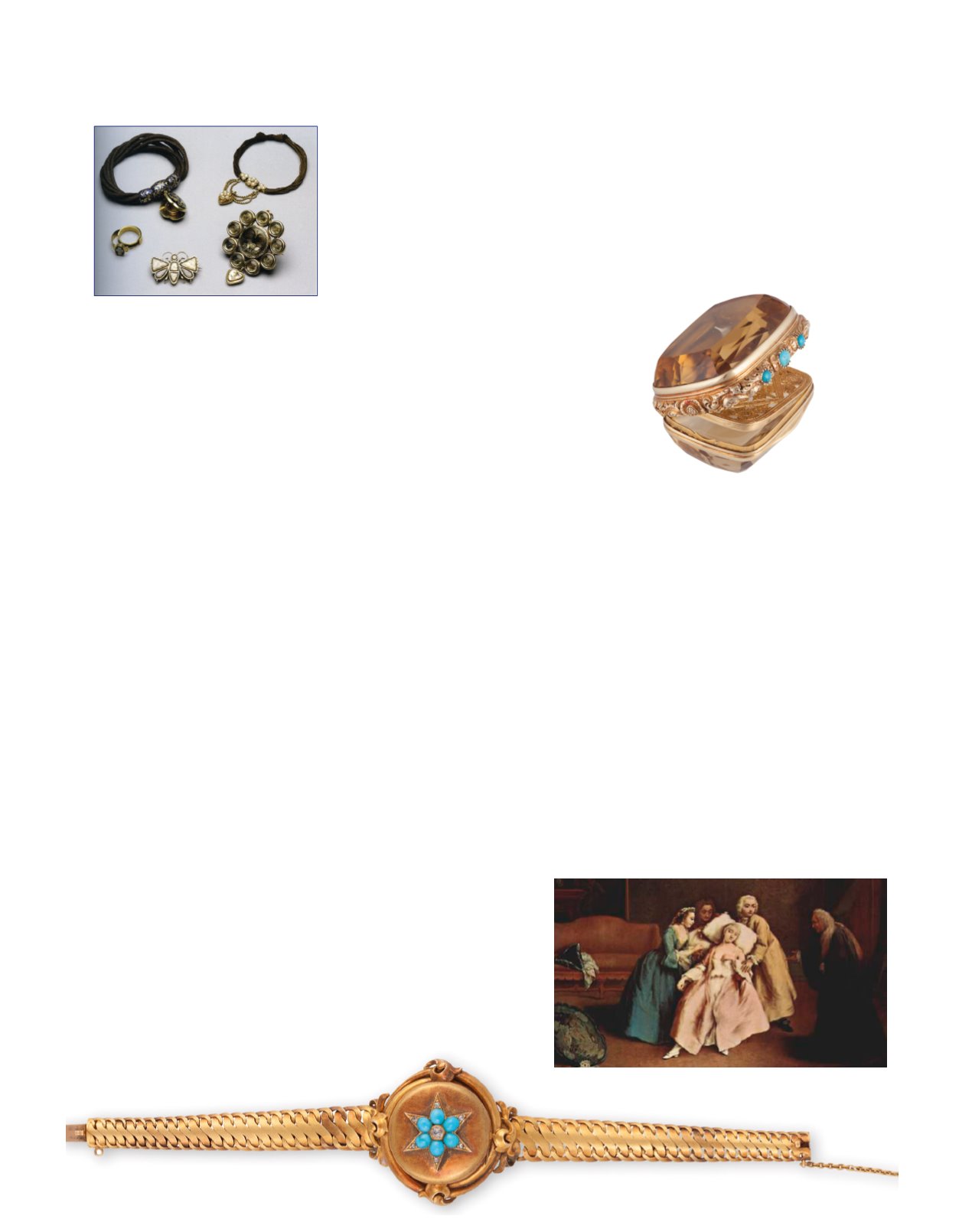
The integration of hair in jewellery is usually associated with mourning jewellery, however for Vic-
torian society it had a much broader significance.The exchange of hair in jewellery was a statement
of sentiment, friendship or courtship, as well as a momentum of a loved one. QueenVictoria herself
felt that hair in jewellery held an element of spirituality.Among the gifts exchanged between Queen
Victoria and the Empress Eugenie in 1855 were hair work bracelets; although these bracelets would
have been professionally made, in order to convey the intended sentiment the Queen and Empresses
own hair would have to have been used.
43 A 19TH CENTURY PENDANT/LOCKETOf round shape, set with a portrait miniature of a lady within a surround of
turquoise cabochons to one side and a glazed locket compartment to the re-
verse containing braided hairwork, suspended from a braided hair double lace,
interspersed with gold links,
pendant length 4.7cm,
€ 700 - 1,000
44 A VICTORIAN TURQUOISE AND DIAMOND LOCKET-BRACELET, CIRCA 1875The circular frontispiece set with old brilliant and rose-cut diamonds and
turquoise in the form of a starburst, hinged to reveal a glazed locket compart-
ment, to “S” link bracelet,
diameter of frontispiece 3.7cm, length of bracelet 18.6cm
€ 700 - 900
45 A GEORGE IV CITRINE AND TURQUOISE VINAIGRETTE, CIRCA 1825-35The body and lid each of a faceted citrine with reeded gold mounts,
the thumbpiece set with three oval cabochon-cut turquoise with
the grill pierced and engraved in floral design, the mount with inset
leaves and flowers, unmarked, width 3.2cm
€ 800 - 1,000
Popular from the late 18th century through the mid-19th century,
vinaigrettes were small containers used for holding various aromatic
substances, usually dissolved in vinegar.A tiny piece of sponge,
soaked in the liquid, was contained beneath the grill. By the 1820s it
was almost exclusively a feminine accessory. Carried in a pocket or
reticule, or suspended from a chatelaine at the waist, it was used to
mask unsanitary odours. Other vinaigrettes contained a mixture of
smelling salts, an ammonia-based inhalant used since ancient times to
revive people who were feeling faint.
44
45