


 58 / 206


58
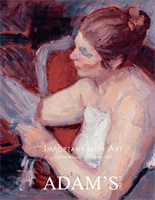
43 RODERIC O’CONOR (1860-1940) Model Reading (1904-5)Oil on panel, 37 x 46cm (14½ x 18’’)
Merchant’s stamp verso,
Blanchet, 20 rue St. Benoit, Paris
Atelier stamp verso
Provenance: Hôtel Drouot, Paris, Vente O’Conor, 7/02/1956; Roland, Browse and Delbanco, London (label verso);
William E and Elizabeth Wallace; Christie’s, London, 8th November 1990, No.103; where purchased
by current owner.
Exhibited: “Roderic O’Conor” Exhibition, Roland, Browse and Delbanco, London 1964, Cat. No.8;
“Roderic O’Conor: A selection of his best work” Exhibition, Roland, Browse and Delbanco,
London 1971 Cat. No.19.
Literature: Benington, Jonathan, ‘Roderic O’Conor’, Dublin, Irish Academic Press, 1992, Catalogue No.119.
This quietly restrained painting was among the lots sold in Paris at the 1956 Hotel Drouot auction of the contents
of the joint studios of Roderic O’Conor and his wife, Renée Honta. The work was among those purchased by Dr.
Henry Roland of Roland, Browse and Delbanco in Cork Street, London, the gallery responsible for introducing
O’Conor’s work to a wider British, Irish and international audience. Many of the works which the gallery bought in
Paris were untitled, and when this painting was first exhibited in London in 1964, and again in 1971, it was shown
under the ascribed, or given, title of
Woman Reading
.
A close analysis of the painting reveals that the woman is in fact not reading, but is in the act of dressing and
is putting on a garment, probably a blouse or chemise. The positioning of her left hand, which is pulling on the
garment, has created a ridge of tension which is further confirmed as such by the excess fabric hanging below
her hand. The positioning of her right arm and her inclined head is a further indication that she is not reading but
is clearly in the process of dressing.
O’Conor’s painting was made in his rue du Cherche Midi studio in Paris, with his model seated on a red fabric
upholstered French armchair, with gilded, fluted wooden arms and back, which appears frequently in his studio
paintings.
O’Conor moved into this Montparnasse studio when he returned to Paris in 1904 following a thirteen–year
association with Brittany where he had painted at Pont-Aven, Le Pouldu and Rochefort-en-Terre as a member of
Gauguin’s circle of artists. The change of environment from rural coastal Brittany to cosmopolitan Paris had an
immediate effect on O’Conor’s subject matter. Vigorously painted landscapes and stormy seas gave way to studio
still-lifes and paintings of female models. This work is indicative of an awareness of Pierre Bonnard’s quiet and
intimate paintings at the turn of the century, and is revealing of O’Conor’s obvious admiration for his work from
this period in Bonnard’s career. Both O’Conor and Bonnard were represented in the sixth, seventh, and eighth
exhibitions in the important series organized by the Barc de Boutteville and shown in his gallery in rue Peletier
in 1894 under the title
Exposition des Peintres Impressionistes et Symbolistes
. O’Conor, a discriminating collector,
also acquired several Bonnard works for his own collection.
The 1904 date on the Blanchet stamp verso also provides useful information in dating of the painting, as Blan-
chet was a well established artist’s colour merchant, framer, and supplier of canvas and related art materials.
The company’s address in 1905 was 20 rue St. Benoit in Montparnasse but later that year they moved to 38 rue
Bonaparte in Montparnasse. This makes it probable that the work was painted by O’Conor circa1904-05.
Roy Johnston, March
2017
€ 18,000 - 25,000